Publications

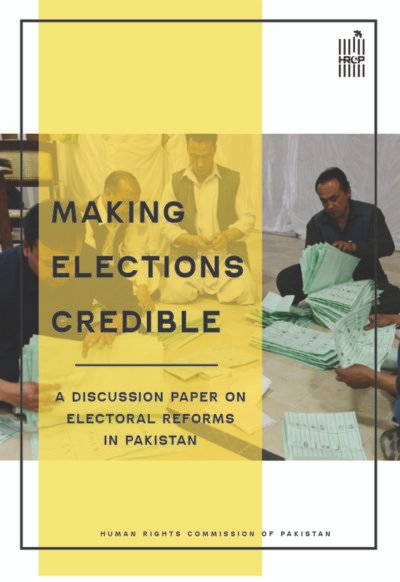
Making Elections Credible

Elections in Pakistan are a contested subject, with the losing side invariably questioning the election’s outcome. The role of undemocratic forces in manipulating the election results has now been established beyond a doubt, putting the integrity of the whole exercise under question. Since elections play a vital role in the strengthening of democracy by letting the people express their will through their votes, this lack of credibility has had serious conse- quences for the country’s political stability. It would not be incorrect to say that unelected forces in Pakistan consider the electoral sys- tem as a mere tool to fulfill the claims of procedural democracy, which effectively does little to change the balance of power in favour of elected people. The Human Rights Commission of Pakistan (HRCP) has remained committed

This is the heading

  • Keyword

  • Year

  • Region

  • Categories

Fighting to breathe

A key area of the decent work deficit in Pakistan is poor occupational safety and health (OSH), which applies to both the formal and informal sectors. Most enterprises in the formal sector are not aware of OSH risks and hazards, nor are they inclined to view these with much sense of urgency. According to reports from the International Labour Organization (ILO), 2.2 million people die every year globally due to work-related accidents or illness, more than 270 million workers are injured and an estimated 160 million suffer work-related illness. In Pakistan, despite the Factories Act 1934 (last amended in 2012), the Hazardous Occupations Rules 1963 and subsequent provincially derived legislation following the devolution of labour to the provinces after the 18th Amendment to the Constitution, there is no independent legislation protecting OSH. Poor implementation of the laws that do exist, weak unionisation and inadequate—even absent—labour inspection mechanisms mean that Pakistan’s OSH standards fall painfully short of internationally accepted benchmarks. Nowhere is this more apparent than in the stone-crushing industry in Punjab, where thousands of workers—lacking protective equipment— inhale crystalline silica dust during industrial processes such as the manufacture of acid-lining mixtures for the metal industry. In the long term, they

Read Here »