Publications

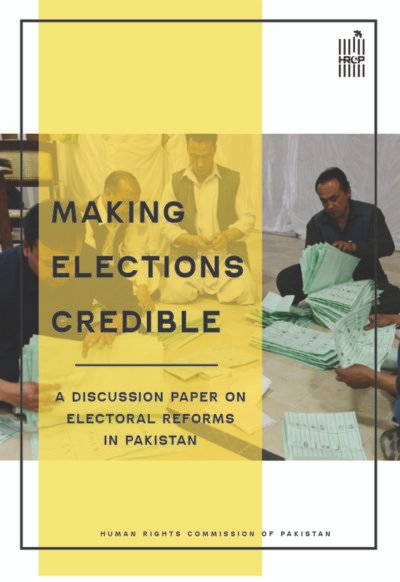
Making Elections Credible

Elections in Pakistan are a contested subject, with the losing side invariably questioning the election’s outcome. The role of undemocratic forces in manipulating the election results has now been established beyond a doubt, putting the integrity of the whole exercise under question. Since elections play a vital role in the strengthening of democracy by letting the people express their will through their votes, this lack of credibility has had serious conse- quences for the country’s political stability. It would not be incorrect to say that unelected forces in Pakistan consider the electoral sys- tem as a mere tool to fulfill the claims of procedural democracy, which effectively does little to change the balance of power in favour of elected people. The Human Rights Commission of Pakistan (HRCP) has remained committed

This is the heading

  • Keyword

  • Year

  • Region

  • Categories

HRCP general body calls for consensus on civilian autonomy, climate justice and land rights

Karachi, 17 November 2024. On concluding its 38th annual general meeting, the general body of the Human Rights Commission of Pakistan (HRCP) draws urgent attention to deteriorating human rights and weakening democracy. It strongly opposes the proposed amendment to the Anti-Terrorism Act 1997 that seeks to authorize the armed forces and civil armed forces to employ 90-day preventive detention. Where the state should be focusing on efforts to uphold the rule of law, reduce violence against women, children and transgender persons, protect the rights of workers and peasants, and fulfil people’s right to health and education, it has instead prioritized its own authority at the expense of democratic norms and people’s fundamental rights. HRCP calls on all political parties to reach a consensus on civilian autonomy and guarding federalism. The government must focus on strengthening trade unions and seriously consider instituting a living wage, especially for vulnerable workers. HRCP also believes that the provision of healthcare and education is the duty of the state. Student unions must be restored and special attention paid to the plight of incarcerated fisherfolk, stateless persons and rising suicides triggered by poverty, particularly in Thar. The contentious provincial labour codes must be revisited in consultation

Read Here »

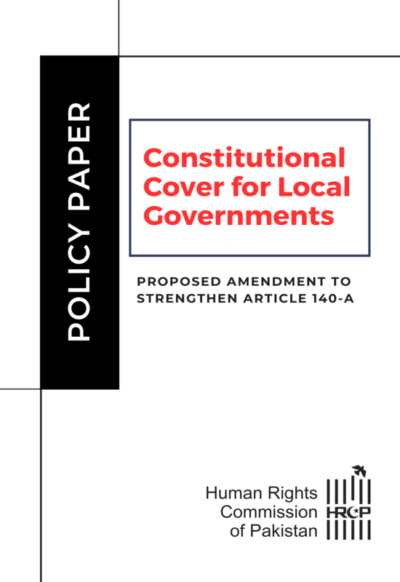
Constitutional Cover for Local Governments

Citizens consume governance directly at the local level; local governments serve as agencies responsible for delivering vital services. However, despite citizens’ repeated demands and over a dozen court verdicts,1 localgovernments in Pakistan have remained, at worst, non-existent, at best, patchy, invariably denied adequate resources through the Provincial Finance Commissions. Irrespective of which political party has been inpower, provincial governments have remained reluctant to empower local tiers of government, often perceiving them unnecessarily as rivals for financial resources and political power. The Human Rights Commission of Pakistan (HRCP) has long recognised that effective, representative and well-resourced local governments are an important measure of the health of a democracy. Drawing on existingconstitutional provisions and international best practices, this policy paper attempts to provide a context for HRCP’s advocacy as well as proposing amendments to Article 140-A of the Constitution, which provides brieflyfor local governments as a responsibility of the provinces, but goes no further in terms of what local governments are responsible for and how their scope of responsibilities should be safeguarded—a criticism levied by many political experts.

Read Here »