Publications

Making Elections Credible

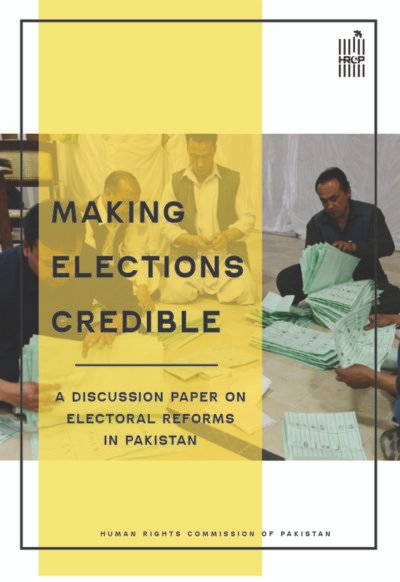
Elections in Pakistan are a contested subject, with the losing side invariably questioning the election’s outcome. The role of undemocratic forces in manipulating the election results has now been established beyond a doubt, putting the integrity of the whole exercise under question. Since elections play a vital role in the strengthening of democracy by letting the people express their will through their votes, this lack of credibility has had serious conse- quences for the country’s political stability. It would not be incorrect to say that unelected forces in Pakistan consider the electoral sys- tem as a mere tool to fulfill the claims of procedural democracy, which effectively does little to change the balance of power in favour of elected people. The Human Rights Commission of Pakistan (HRCP) has remained committed

This is the heading

  • Keyword

  • Year

  • Region

  • Categories

Gilgit-Baltistan: The long wait for a constitutional identity

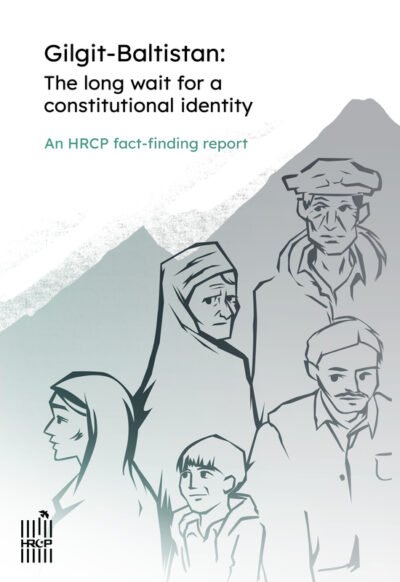
Gilgit-Baltistan (GB), which remains a de facto administrative unit of Pakistan—its citizens deprived of the right to political representation at the level of Parliament—has long been an area of concern for the Human Rights Commission of Pakistan (HRCP). The organisation continues to advocate that GB’s people should enjoy the same fundamental rights as all citizens and residents of Pakistan. Accordingly, HRCP carries out high-profile fact-finding missions to GB periodically to assess the state of human rights in the area and recommend to policymakers measures that would alleviate the grievances documented during these missions. To this end, HRCP led a mission to GB during 4–9 June 2022, comprising HRCP Council members Salima Hashmi and Muzaffar Hussain, senior journalist Ghazi Salahuddin, and staff members Israruddin Israr (Gilgit), Zaheera Siraj (Gilgit), and Nadeem Abbas (Islamabad). The aims of the mission were to: – Assess the implications of the political status of GB for the local population. – Determine the extent and impact of curbs on freedom of movement, expression, association, and assembly in the area. – Establish facts concerning the misuse of anti-terrorism laws—especially under Schedule IV of the Anti-Terrorism Act 1997—against human rights defenders and political activists. – Assess people’s access to

Read Here »

A Clarion Call for Climate Justice

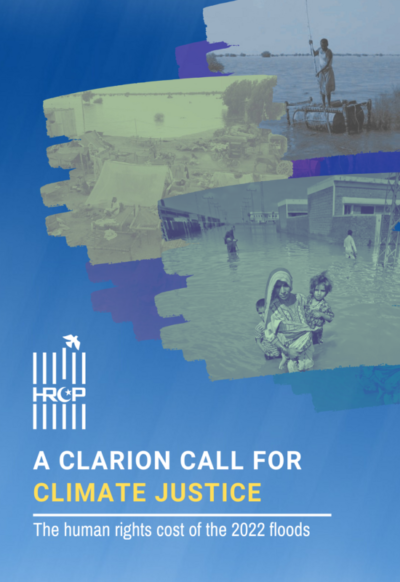
The impact of the 2022 floods in Pakistan cannot be understated. According to the country’s National Disaster Management Authority (NDMA), a total of 1,739 lives were lost, 12,867 people were injured and over 33 million people were affected. With a third of the country submerged under water, citizens in 90 districts hit by the calamity were left homeless. Over 1.7 million houses were destroyed by torrential rains, glacial lake outburst floods (GLOFs) and the flooding of the Indus River and its tributaries. The havoc wreaked by these floods have also laid bare the socioeconomic fault lines in Pakistan, exacerbating the effects of runaway inflation, an energy crisis and massive food insecurity. These factors, combined with recurring climate emergencies, such as heatwaves, smog and droughts on an already struggling population, leave little room for relief and rehabilitation. This situation underscores just how integral environmental rights are to the realisation of fundamental human rights, such as the rights to life, health, food, water and sanitation. Without a safe, clean, healthy and sustainable environment, people (particularly vulnerable groups) cannot live at a level commensurate with the minimum standards of human dignity. This is why a new social contract must be envisioned, one rooted

Read Here »

The Ravi Riverfront Urban Development Project

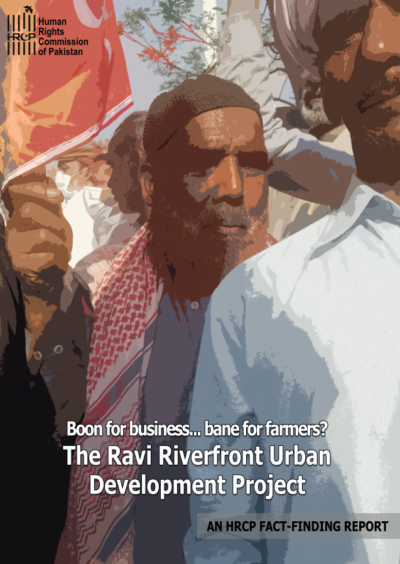
Since late 2020, the Human Rights Commission of Pakistan (HRCP) has been alarmed by the launch of the mammoth Ravi Riverfront Urban Development Project (RUDP) by the Punjab government under the direct supervision of the prime minister. The project has been plagued by myriad controversies since the outset—from the expected damage to the environment to the very real loss of livelihoods for small landowners. Moreover, the involvement of private real estate developers in the reportedly multi-trillion-rupee venture makes the entire exercise even more suspect vis-à-vis official claims that the exercise is for the ‘benefit of the masses.’ Farmers, whose lands the government has begun to take over, are up in arms against forcible evictions and various state pressure tactics, while activists continue to voice their concerns about the project’s environmental cost. With numerous civil society organisations and rights activists stirring into action, HRCP constituted a fact-finding mission to scrutinise the various impacts of the project, most notably violations of human rights, and to present possible mitigation measures to assist landowners as well as other civil society partners. In this regard, a consultation was organised on 26 January 2021, mostly with subject experts, urban planners, environmentalists, lawyers and HRCP members, including

Read Here »