Publications

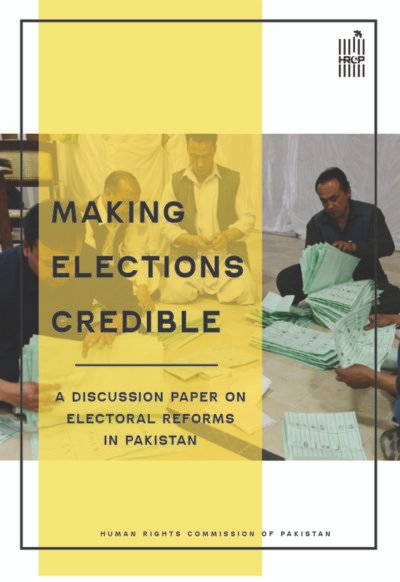
Making Elections Credible

Elections in Pakistan are a contested subject, with the losing side invariably questioning the election’s outcome. The role of undemocratic forces in manipulating the election results has now been established beyond a doubt, putting the integrity of the whole exercise under question. Since elections play a vital role in the strengthening of democracy by letting the people express their will through their votes, this lack of credibility has had serious conse- quences for the country’s political stability. It would not be incorrect to say that unelected forces in Pakistan consider the electoral sys- tem as a mere tool to fulfill the claims of procedural democracy, which effectively does little to change the balance of power in favour of elected people. The Human Rights Commission of Pakistan (HRCP) has remained committed

This is the heading

  • Keyword

  • Year

  • Region

  • Categories

A Tainted Election Pakistan at the polls

The 8 February 2024 general elections have concluded relatively peacefully, with a reasonable voter turnout of 47 percent. An estimated 60 million people have exercised their right to vote for 265 National Assembly and 590 provincial assembly constituencies. In a positive sign, this election has brought to office 12 women—the highest ever number elected to general seats. However, the perception of having held a smooth, orderly election is as important as making it appear to be a credible exercise. Sadly, elections in this country have suffered from a consistent crisis of integrity. The 2024 election too was preceded by a long period of political turmoil and polarization, punctuated by violence perpetrated by militants, raising doubts as to the certainty and fairness of the polls, alongside hopes that they would usher in sorely needed political and economic stability. Soon after polling began on 8 February, people realized that an internet and cellular services shutdown had occurred across the country; it remained in place until the following morning. This affected not only the polling process, but also how it was reported by the media. With last-minute changes in voters’ polling stations in many cases, people found it difficult to obtain the necessary

Read Here »

Making Elections Credible

Elections in Pakistan are a contested subject, with the losing side invariably questioning the election’s outcome. The role of undemocratic forces in manipulating the election results has now been established beyond a doubt, putting the integrity of the whole exercise under question. Since elections play a vital role in the strengthening of democracy by letting the people express their will through their votes, this lack of credibility has had serious conse- quences for the country’s political stability. It would not be incorrect to say that unelected forces in Pakistan consider the electoral sys- tem as a mere tool to fulfill the claims of procedural democracy, which effectively does little to change the balance of power in favour of elected people. The Human Rights Commission of Pakistan (HRCP) has remained committed to the ideals of constitutionalism, democratic governance and the rule of law for decades. Electoral reforms to bring about free and fair elections are hence crucial in fulfilling these ideals. While ac- knowledging that elections everywhere are in need of constant reform, HRCP feels it impera- tive to address serious gaps in Pakistan’s electoral system, not only with regards to the obvious credibility crisis but also pertaining to how the

Read Here »

Mapping Social Movements in Pakistan

The twenty-first century ushered in a new era in social movements globally, with anti-authoritarian and anti-austerity movements like the Arab Spring and Occupy Wall Street taking centre-stage. The rise of new media technologies helped these movements to mobilise in the online realm when they met with on-ground opposition, and garner support on an international level. Yet, in Pakistan—a country with a turbulent relationship with freedom of expression and movement, where resistance has historically been stifled, and surveillance has been the norm—the rise of large-scale social movements has been slow, albeit steady. The first decade of the twenty-first century featured multiple forms of contentious politics: (i) the lawyers’ movement for the restoration of the judiciary which culminated in a broad political movement against Pervez Musharraf’s military dictatorship; (ii) the nation-wide campaigns against privatisation of public utilities (Pakistan Telecommunication Corporation Limited); (iii) the region- and city-specific peasant and labour mobilisations for agrarian land rights and improved wages; (iv) the struggles of public-sector employees for better service structures, and (v) the ethno-nationalist uprisings in peripheral regions away from central Punjab districts. By and large, these social movements took place in isolation, without a broadbased network among activists and mobilisers which could synthesise the

Read Here »

A BID FOR CHANGE

The right to freedom of peaceful assembly allows a democratic society to function smoothly by giving every citizen the chance to express their beliefs, convey their grievances and pursue change collectively. This right also facilitates a participatory form of government and is simultaneously dependent on other rights, such as the right to freedom of expression, movement and association. People’s freedom to assemble peacefully is enshrined in Article 16 of Pakistan’s constitution as follows: Every citizen shall have the right to assemble peacefully and without arms, subject to any reasonable restrictions imposed by law in the interest of public order. This right is also preserved by international law, such as the Universal Declaration of Human Rights (UDHR) of which Pakistan is one of the founding signatories. The UDHR, together with the International Covenant on Civil and Political Rights (ICCPR) and the International Covenant on Economic, Social and Cultural Rights (ICESCR), form the ‘International Bill of Human Rights’ and together enumerate a series of rights, including the right to freedom of peaceful assembly, that call upon state parties to protect, respect and fulfil these rights. Pakistan ratified the ICESCR in 2008 and the ICCPR in 2010, hence undertaking an obligation to bring

Read Here »

State of Human Rightsin 2021

Although 2021 was the second consecutive year of the Covid-19 pandemic that has raged across so many countries, including Pakistan, it began on a promising note—the world seemed to have found a solution in the form of a vaccine. In Pakistan, too, the vaccination campaign began in March and continued smoothly throughout the year, despite periodic surges in infections owing to new variants of thedisease. For the Human Rights Commission of Pakistan (HRCP), however, it was an exceptionally sad year because of the loss of two formidable colleagues in April. The deaths of vice-chair HRCP Khyber Pakhtunkhwa Kamran Arif and former secretary-general I. A. Rehman left a vacuum in the human rights movement that will be very hard to fill. We also lost two Council members, Zaman Khan and Sindhu Mukesh, in the latter part of the year. For HRCP, the right to freedom of expression was the most pressing issue of the year, with a direct bearing on all other rights, including press freedom, freedom of assembly and association, parliamentary supremacy and the state of democracy. Crucial violations such as enforced disappearances and police excesses persisted, while the demands of marginalized sections of society were often undermined by constant

Read Here »