Publications

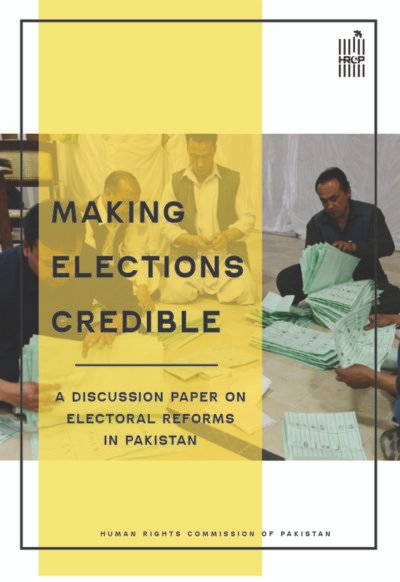
Making Elections Credible

Elections in Pakistan are a contested subject, with the losing side invariably questioning the election’s outcome. The role of undemocratic forces in manipulating the election results has now been established beyond a doubt, putting the integrity of the whole exercise under question. Since elections play a vital role in the strengthening of democracy by letting the people express their will through their votes, this lack of credibility has had serious conse- quences for the country’s political stability. It would not be incorrect to say that unelected forces in Pakistan consider the electoral sys- tem as a mere tool to fulfill the claims of procedural democracy, which effectively does little to change the balance of power in favour of elected people. The Human Rights Commission of Pakistan (HRCP) has remained committed

This is the heading

  • Keyword

  • Year

  • Region

  • Categories

Abolition of bonded labour in Pakistan

The standard Lorem Ipsum passage, used since the 1500s “Lorem ipsum dolor sit amet, consectetur adipiscing elit, sed do eiusmod tempor incididunt ut labore et dolore magna aliqua. Ut enim ad minim veniam, quis nostrud exercitation ullamco laboris nisi ut aliquip ex ea commodo consequat. Duis aute irure dolor in reprehenderit in voluptate velit esse cillum dolore eu fugiat nulla pariatur. Excepteur sint occaecat cupidatat non proident, sunt in culpa qui officia deserunt mollit anim id est laborum.” Section 1.10.32 of “de Finibus Bonorum et Malorum”, written by Cicero in 45 BC “Sed ut perspiciatis unde omnis iste natus error sit voluptatem accusantium doloremque laudantium, totam rem aperiam, eaque ipsa quae ab illo inventore veritatis et quasi architecto beatae vitae dicta sunt explicabo. Nemo enim ipsam voluptatem quia voluptas sit aspernatur aut odit aut fugit, sed quia consequuntur magni dolores eos qui ratione voluptatem sequi nesciunt. Neque porro quisquam est, qui dolorem ipsum quia dolor sit amet, consectetur, adipisci velit, sed quia non numquam eius modi tempora incidunt ut labore et dolore magnam aliquam quaerat voluptatem. Ut enim ad minima veniam, quis nostrum exercitationem ullam corporis suscipit laboriosam, nisi ut aliquid ex ea commodi consequatur? Quis autem vel eum iure

Read Here »

HRCP launches fact-finding report on rights violations in Balochistan’s coal mines

Quetta, 24 November 2022. In its fact-finding report titled Beneath the surface: Rights violations in Balochistan’s coal mines, launched in Quetta earlier today, the Human Rights Commission of Pakistan (HRCP) has underscored the alarming frequency of mining-related deaths and injuries in the region. Based on field visits and consultations with coalminers, labour unions and government departments, the report recommends that the number of trained government safety inspectors and the frequency of their inspections be increased to maintain safety standards and reduce the number of mining accidents. Mine owners and contractors must also ensure a functioning ambulance service with onsite emergency health workers and regular internal safety inspections at every mining site. Mining tunnels must be constructed in accordance with the law, and kept well ventilated to allow both the entry of clean air and to avoid methane build-ups. It is imperative that the federal government ratify ILO Convention C-176 so that such minimum standards of occupational safety and health are determined and implemented. Coal miners must further be registered and made eligible for EOBI social security and Workers’ Welfare Fund benefits. The disparity in the treatment of migrant mine workers must be addressed as well by registering them so that they

Read Here »

Fighting to breathe

A key area of the decent work deficit in Pakistan is poor occupational safety and health (OSH), which applies to both the formal and informal sectors. Most enterprises in the formal sector are not aware of OSH risks and hazards, nor are they inclined to view these with much sense of urgency. According to reports from the International Labour Organization (ILO), 2.2 million people die every year globally due to work-related accidents or illness, more than 270 million workers are injured and an estimated 160 million suffer work-related illness. In Pakistan, despite the Factories Act 1934 (last amended in 2012), the Hazardous Occupations Rules 1963 and subsequent provincially derived legislation following the devolution of labour to the provinces after the 18th Amendment to the Constitution, there is no independent legislation protecting OSH. Poor implementation of the laws that do exist, weak unionisation and inadequate—even absent—labour inspection mechanisms mean that Pakistan’s OSH standards fall painfully short of internationally accepted benchmarks. Nowhere is this more apparent than in the stone-crushing industry in Punjab, where thousands of workers—lacking protective equipment— inhale crystalline silica dust during industrial processes such as the manufacture of acid-lining mixtures for the metal industry. In the long term, they

Read Here »

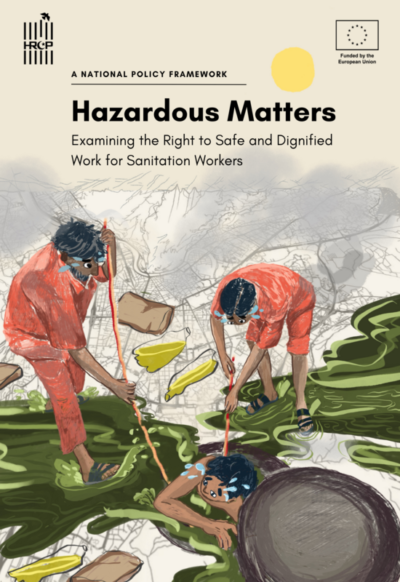
Hazardous Matters

Examining the Right to Safe and Dignified Work for Sanitation Workers Sanitation workers perform essential public services. They sweep roads, streets and other public areas, remove waste and clean gutters and sewers. Without their services, public streets and roads would be impossible to use and the country’s sewerage systems would break down. Clean streets, gutters and drains are also essential to preventing the spread of contagious diseases. Despite the crucial nature of their work, sanitation workers are among the most marginalized and are often invisible in discussions and scholarship around Pakistan’s workforce. They work in hazardous conditions, clearing toxic and noxious substances, almost always without any protective equipment whatsoever. In addition, sanitation workers are often paid below the officially prescribed minimum wage1 and lack job security and other benefits. An overwhelming majority of sanitation workers belong to religious minorities that have historically been part of ‘the lowest of the low’ communal matrix and face social stigma and systemic discrimination due to the nature of their work and their caste-based social background.

Read Here »