Publications

Making Elections Credible

Elections in Pakistan are a contested subject, with the losing side invariably questioning the election’s outcome. The role of undemocratic forces in manipulating the election results has now been established beyond a doubt, putting the integrity of the whole exercise under question. Since elections play a vital role in the strengthening of democracy by letting the people express their will through their votes, this lack of credibility has had serious conse- quences for the country’s political stability. It would not be incorrect to say that unelected forces in Pakistan consider the electoral sys- tem as a mere tool to fulfill the claims of procedural democracy, which effectively does little to change the balance of power in favour of elected people. The Human Rights Commission of Pakistan (HRCP) has remained committed

This is the heading

  • Keyword

  • Year

  • Region

  • Categories

HRCP general body calls for consensus on civilian autonomy, climate justice and land rights

Karachi, 17 November 2024. On concluding its 38th annual general meeting, the general body of the Human Rights Commission of Pakistan (HRCP) draws urgent attention to deteriorating human rights and weakening democracy. It strongly opposes the proposed amendment to the Anti-Terrorism Act 1997 that seeks to authorize the armed forces and civil armed forces to employ 90-day preventive detention. Where the state should be focusing on efforts to uphold the rule of law, reduce violence against women, children and transgender persons, protect the rights of workers and peasants, and fulfil people’s right to health and education, it has instead prioritized its own authority at the expense of democratic norms and people’s fundamental rights. HRCP calls on all political parties to reach a consensus on civilian autonomy and guarding federalism. The government must focus on strengthening trade unions and seriously consider instituting a living wage, especially for vulnerable workers. HRCP also believes that the provision of healthcare and education is the duty of the state. Student unions must be restored and special attention paid to the plight of incarcerated fisherfolk, stateless persons and rising suicides triggered by poverty, particularly in Thar. The contentious provincial labour codes must be revisited in consultation

Read Here »

Constitutional Cover for Local Governments

Citizens consume governance directly at the local level; local governments serve as agencies responsible for delivering vital services. However, despite citizens’ repeated demands and over a dozen court verdicts,1 localgovernments in Pakistan have remained, at worst, non-existent, at best, patchy, invariably denied adequate resources through the Provincial Finance Commissions. Irrespective of which political party has been inpower, provincial governments have remained reluctant to empower local tiers of government, often perceiving them unnecessarily as rivals for financial resources and political power. The Human Rights Commission of Pakistan (HRCP) has long recognised that effective, representative and well-resourced local governments are an important measure of the health of a democracy. Drawing on existingconstitutional provisions and international best practices, this policy paper attempts to provide a context for HRCP’s advocacy as well as proposing amendments to Article 140-A of the Constitution, which provides brieflyfor local governments as a responsibility of the provinces, but goes no further in terms of what local governments are responsible for and how their scope of responsibilities should be safeguarded—a criticism levied by many political experts.

Read Here »

Abolition of bonded labour in Pakistan

The standard Lorem Ipsum passage, used since the 1500s “Lorem ipsum dolor sit amet, consectetur adipiscing elit, sed do eiusmod tempor incididunt ut labore et dolore magna aliqua. Ut enim ad minim veniam, quis nostrud exercitation ullamco laboris nisi ut aliquip ex ea commodo consequat. Duis aute irure dolor in reprehenderit in voluptate velit esse cillum dolore eu fugiat nulla pariatur. Excepteur sint occaecat cupidatat non proident, sunt in culpa qui officia deserunt mollit anim id est laborum.” Section 1.10.32 of “de Finibus Bonorum et Malorum”, written by Cicero in 45 BC “Sed ut perspiciatis unde omnis iste natus error sit voluptatem accusantium doloremque laudantium, totam rem aperiam, eaque ipsa quae ab illo inventore veritatis et quasi architecto beatae vitae dicta sunt explicabo. Nemo enim ipsam voluptatem quia voluptas sit aspernatur aut odit aut fugit, sed quia consequuntur magni dolores eos qui ratione voluptatem sequi nesciunt. Neque porro quisquam est, qui dolorem ipsum quia dolor sit amet, consectetur, adipisci velit, sed quia non numquam eius modi tempora incidunt ut labore et dolore magnam aliquam quaerat voluptatem. Ut enim ad minima veniam, quis nostrum exercitationem ullam corporis suscipit laboriosam, nisi ut aliquid ex ea commodi consequatur? Quis autem vel eum iure

Read Here »

HRCP launches fact-finding report on rights violations in Balochistan’s coal mines

Quetta, 24 November 2022. In its fact-finding report titled Beneath the surface: Rights violations in Balochistan’s coal mines, launched in Quetta earlier today, the Human Rights Commission of Pakistan (HRCP) has underscored the alarming frequency of mining-related deaths and injuries in the region. Based on field visits and consultations with coalminers, labour unions and government departments, the report recommends that the number of trained government safety inspectors and the frequency of their inspections be increased to maintain safety standards and reduce the number of mining accidents. Mine owners and contractors must also ensure a functioning ambulance service with onsite emergency health workers and regular internal safety inspections at every mining site. Mining tunnels must be constructed in accordance with the law, and kept well ventilated to allow both the entry of clean air and to avoid methane build-ups. It is imperative that the federal government ratify ILO Convention C-176 so that such minimum standards of occupational safety and health are determined and implemented. Coal miners must further be registered and made eligible for EOBI social security and Workers’ Welfare Fund benefits. The disparity in the treatment of migrant mine workers must be addressed as well by registering them so that they

Read Here »

Fighting to breathe

A key area of the decent work deficit in Pakistan is poor occupational safety and health (OSH), which applies to both the formal and informal sectors. Most enterprises in the formal sector are not aware of OSH risks and hazards, nor are they inclined to view these with much sense of urgency. According to reports from the International Labour Organization (ILO), 2.2 million people die every year globally due to work-related accidents or illness, more than 270 million workers are injured and an estimated 160 million suffer work-related illness. In Pakistan, despite the Factories Act 1934 (last amended in 2012), the Hazardous Occupations Rules 1963 and subsequent provincially derived legislation following the devolution of labour to the provinces after the 18th Amendment to the Constitution, there is no independent legislation protecting OSH. Poor implementation of the laws that do exist, weak unionisation and inadequate—even absent—labour inspection mechanisms mean that Pakistan’s OSH standards fall painfully short of internationally accepted benchmarks. Nowhere is this more apparent than in the stone-crushing industry in Punjab, where thousands of workers—lacking protective equipment— inhale crystalline silica dust during industrial processes such as the manufacture of acid-lining mixtures for the metal industry. In the long term, they

Read Here »

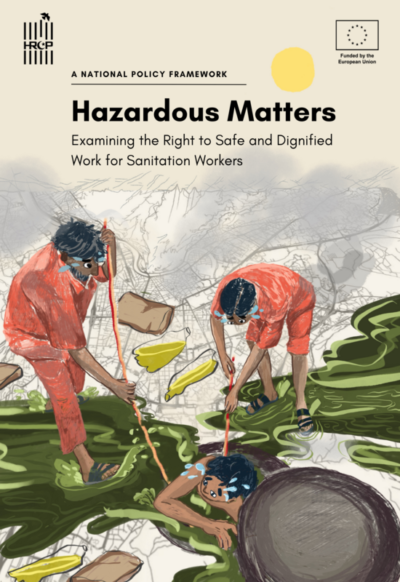
Hazardous Matters

Examining the Right to Safe and Dignified Work for Sanitation Workers Sanitation workers perform essential public services. They sweep roads, streets and other public areas, remove waste and clean gutters and sewers. Without their services, public streets and roads would be impossible to use and the country’s sewerage systems would break down. Clean streets, gutters and drains are also essential to preventing the spread of contagious diseases. Despite the crucial nature of their work, sanitation workers are among the most marginalized and are often invisible in discussions and scholarship around Pakistan’s workforce. They work in hazardous conditions, clearing toxic and noxious substances, almost always without any protective equipment whatsoever. In addition, sanitation workers are often paid below the officially prescribed minimum wage1 and lack job security and other benefits. An overwhelming majority of sanitation workers belong to religious minorities that have historically been part of ‘the lowest of the low’ communal matrix and face social stigma and systemic discrimination due to the nature of their work and their caste-based social background.

Read Here »

Open letter calling for the protection of Afghan refugees in Pakistan

His Excellency Filippo GrandiUnited Nations High Commissioner for Refugees 31 October 2023 Excellency, Re: Open letter calling for the protection of Afghan refugees in Pakistan The Human Rights Commission of Pakistan (HRCP) is greatly concerned by the Pakistan government’s decision to expel all undocumented foreigners by 1 November 2023, the bulk of whom comprise Afghan nationals. HRCP strongly believes that this decision—which will apply to an estimated 1.7 million Afghans—could trigger a humanitarian crisis. The decision amounts to forced repatriation, which is not recognised under international customary law, and will invariably affect vulnerable refugees and asylum seekers, which include women, children, the elderly, persons living with disabilities, persons from low-income groups, and Afghans at risk because of their professions—many of whom fled Afghanistan after the Afghan Taliban took over the government in August 2021. Despite drawing criticism from human rights organisations and networks, the government has shown no signs of reconsidering this decision, having gone so far as to prevent prominent members of civil society from expressing their views on this matter at public events. The interior minister Sarfraz Bugti has also made it clear that this phase will be followed by the deportation of foreigners with legitimate documents, including

Read Here »

Allegations of blasphemy and mob violence in Mujahid Colony, Sargodha

On 25 May 2024, a large mob gathered in Mujahid Colony in Sargodha and attacked the house of Nazir (Lazar) Masih and his son Sultan Masih, following allegations that they had deliberately burnt pages of the Holy Quran. An announcement to this effect was reportedly made from a local mosque, inciting a mob of about 2,000 people to gather outside the adjoining homes of Nazir and Sultan Masih, demanding they be put to death. Videos of the mob and their demand went viral on social media platforms soon after. The police were able to eventually evacuate nine members of the family. However, Nazir Masih was caught by the mob and severely beaten. He was taken to the hospital in critical condition and succumbed to his injuries a week later on the night between 2 and 3 June 2024. On 28 May 2024, a fact-finding mission led by the Human Rights Commission of Pakistan (HRCP) visited Sargodha. The mission comprised Maheen Pracha (staff member), Asad Jamal (lawyer and human rights activist) and Yaqoob Khan Bangash (academic and human rights activist). They met local religious, community and political leaders from the Christian community, senior police officers, members of the victim’s family, and

Read Here »

State of Human Rights in 2022

It would not be incorrect to say that things came to a head in many ways for Pakistan in 2022. The year began with a sense of control and preparedness about the Covid-19 pandemic, even though there were hundreds of thousands of new cases across the country. Unfortunately, the political and economic scenario was not as optimistic. As the governments tried to negotiate kinder deals with international lenders, the economy took a nosedive. Inflationary pressure made ordinary people’s lives more difficult; businesses were stalled, leading to unemployment and poverty. It was a year of political unrest and instability, exposing the fragile moorings of our democratic system like never before. The legislature and executive struggled with a crisis of credibility, and the judicial overreach, instead of solving the ensuing constitutional and political crises, only made matters worse. Draconian colonial-era laws continued to be used, as generously as before, against political opponents throughout the year. Moreover, people’s rights to privacy and dignity were violated in the form of audio and video leaks, with no one taking the necessary steps to fix responsibility for undertaking this illegal invasion of privacy and seeking accountability from those found responsible for such acts. Resurgence of terrorism

Read Here »