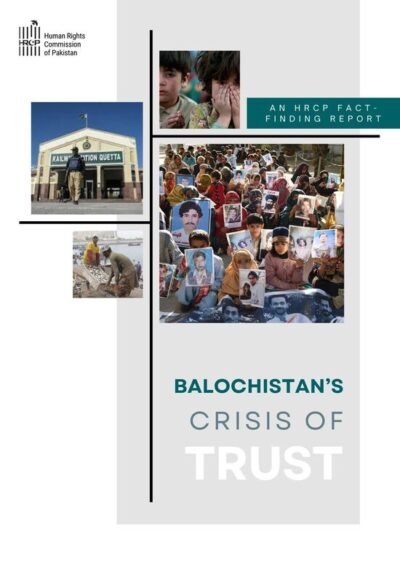
This report documents the observations and recommendations of a fact-finding mission to Balochistan undertaken by the Human Rights Commission of Pakistan (HRCP) in response to escalating concerns
over the deteriorating state of fundamental rights and civic freedoms in the province.
The mission’s terms of reference were to:
- Assess the state of fundamental freedoms (freedom of expression, assembly, association, and movement) in
Balochistan, with a focus on recent legal and policy developments impacting civic space. - Document the scale and impact of media censorship and threats to journalists, including violence, intimidation, and restrictions on news coverage.
- Assess the scale of incidence of enforced disappearances, extrajudicial killings, and arbitrary detentions, particularly of activists, students and members of the Baloch Yakjehti Committee (BYC).
- Examine the reported repression of rights-based movements and peaceful protest, including the use of anti-terrorism and preventive detention laws against non-violent activists and demonstrators.
- Evaluate the consequences of Internet shutdowns, closure of universities, and other restrictions on civic life and access to information.
- Assess the broader impact of conflict and militarization on civilian life, including the effect on education, civil society (including non-Baloch settlers), and the protection of human rights defenders.
The mission took place from 9 to 12 July 2025 and was restricted to Quetta for reasons of security. The team comprised HRCP chairperson Asad Iqbal Butt, co-chair Munizae Jahangir, Balochistan vice-chair Kashif Panezai, Council members Habib Tahir and Sadia Baloch, staff members Maheen Pracha and Fareed Shahwani, and
senior journalist Arifa Noor.
The mission gratefully acknowledges the insights shared by a wide range of respondents, including six political parties, academics from the University of Balochistan, representatives of the Balochistan Students Organization (BSO), members of the High Court Bar Association, activists from the BYC, and diverse civil society actors
such as labour unions, women’s rights defenders and journalists.
The mission also values the opportunity to have engaged with the governor and chief minister of the province, as well as senior civil servants, including officials from the civil secretariat as well as police
and prisons departments.
At the outset, the mission observes that this was at least the eighth such fact-finding mission to Balochistan since 2005. Many recommendations have remained consistent over the course of 20 years with little progress reported by successive missions—a matter that HRCP urges the state to consider seriously.