Everyone has the right to freedom of thought, conscience and religion… to manifest his religion or belief in teaching, practice, worship and observance.
— Article 18, Universal Declaration of Human Rights
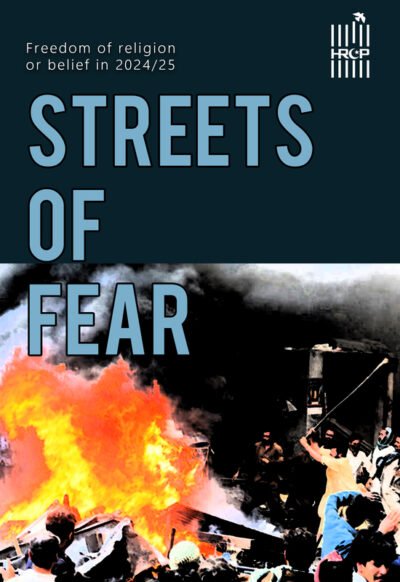
In Pakistan, religious minorities continue to face marginalization. The transgressions of their fundamental constitutional rights, mainly the ‘right to profess, practice, and propagate’ religion or faith under Article 20 of the Constitution, by the religious majority have pushed the minorities over the edge. Their exclusion and ongoing victimization have compelled the minorities to prefer living in tight-knit areas that sometimes resemble slums. This report, documenting the violations related to freedom of religion or belief (FORB) from 1 July 2024 to 30 June 2025, shows a picture as grim as in previous reports.
The violence against the minorities has increased. There have been numerous targeted killings of Ahmadis. In one instance, a man was lynched just a short distance from a sizeable contingent of police in the middle of a busy market of Pakistan’s largest city. Places of worship have been partially or wholly demolished by law enforcement agencies, despite some of them having the protection of a high court verdict. Several incidents of grave desecration were reported from all over the country.
Most alarmingly, two individuals accused of blasphemy were extrajudicially killed by the police while they sought police protection from a hostile mob bent upon lynching them. This casts a shadow on our law enforcement agencies. Both victims were Muslims.
Christian and Hindu minority rights activists have repeatedly raise alarms about the forced conversion of young girls in Punjab and Sindh. This report cites numerous instances where the girls allegedly abducted or lured into leaving their homes were under 18, clearly violating the federal and provincial minimum age requirements for
marriage. In some cases, there is a clear pattern of abducting girls and then coercing them into marriage after their conversion to Islam.
In the last quarter of 2024/25, the country watched live-streamed hearings of a writ petition filed by the parents of young men and women who were allegedly honey-trapped into false blasphemy cases. The hearings revealed that the youngsters were criminally entrapped, allegedly with the collusion of Federal Investigation Agency (FIA) officials. Multiple attempts were made to disrupt the court’s proceedings by a ‘private entity’ that the petitioners accused of conducting illegal arrests.
Hate speech has been on the rise. Death threats were directed at the chief justice of the Supreme Court when the court granted bail to an Ahmadi individual. An elected senator was publicly insulted, particularly by some pro-right-wing social media channels, which also questioned his patriotism when he spoke out in defence of religious
minorities. The blatant ways in which these hateful comments were made were unsettling.
The United Nations and other human rights organizations have consistently expressed concerns about the treatment of minorities in Pakistan. Among those raising these concerns was the United Nations Special Rapporteur on Freedom of Religion or Belief. The Human Rights Commission of Pakistan (HRCP) has specifically highlighted issues throughout the year through its press releases and fact-finding reports.
The report also notes with concern the tilt among the bar associations towards the right-wing forces as they continue to adopt positions favoured by the extreme religious parties over serious matters of fundamental human rights.
On the positive side, the federal government has passed the Child Marriage Restraint Act 2025, which establishes the minimum marriage age of 18 for both men and women. In another development, Punjab, Sindh, and Balochistan have joined Khyber Pakhtunkhwa in passing laws to establish research-based centres of excellence on countering violent extremism.