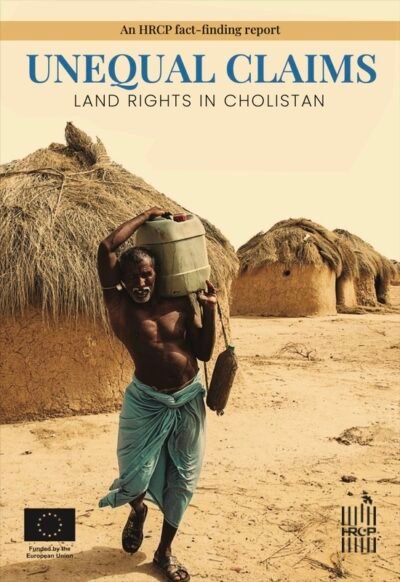
Cholistan is arguably one of Pakistan’s most neglected and marginalized regions. In terms of size, it covers about 6.6 million acres and is spread over seven union councils (UCs) in three districts of South Punjab: Bahawalpur, Bahawalnagar and Rahim Yar Khan. For locals, the region is divided into the populous Lesser Cholistan and sparsely populated Greater Cholistan, which includes the ‘deep desert’. Largely comprising a desert area, Cholistan stretches over 450 kilometres in length, with a width ranging from 30 to 200 km. The 2017 census reported the human population of Cholistan to be 276,674, with Hindus being the largest religious minority group. Cholistan accounts for 13 percent of Pakistan’s meat production and has an estimated livestock population of 1.38 million.
The Human Rights Commission of Pakistan (HRCP) has consistently raised its voice for the rights of the Cholistani people. In its recent fact-finding mission report of South Punjab, several issues related to Cholistan were highlighted, including a major one about alleged irregularities in land allotments. The report captured several testimonies from residents who expressed grievances about land distribution in Cholistan. In 2023, the residents of Cholistan decided to hold a protest to demand fair land distribution. However, the district administration refused to allow the protest.
Meanwhile, the Punjab caretaker government announced in February 2024 a new land scheme with about 26,000 Cholistanis as beneficiaries. Where the scheme was considered a minor success, the relief was only incomplete and temporary HRCP received reports reinforcing alleged irregularities in allotments of land and indicating that certain actors were manipulating local organizations to advance their vested interests in the region.
Considering the factors mentioned above, HRCP decided to conduct a fact-finding mission to Cholistan from 28 to 31 October 2024. The mission comprised Council member Sadia Bokhari, HRCP member and senior lawyer Asad Jamal, and staff members Faisal Tangwani and Salman Farrukh. The terms of reference for the mission were as follows:
- Document the implementation of land allotment schemes for indigenous Cholistanis and identify any irregularities and gaps, including any instances of faith-based discrimination in this context.
- Assess the role of state authorities in allotting land, including but not restricted to the Cholistan Development Authority and revenue officers.
- To assess the role of local rights-based movements engaged in advocating for indigenous people’s land rights in Cholistan.
The mission visited different areas of district Bahawalpur, including Yazman and Channan Peer, as well as various small settlements in Greater Cholistan, each linked to a toba (a large natural or man-made pond used as the main source of water for the residents and their cattle).
The mission interacted with more than 30 respondents in focus group discussions (FGDs) and informal interviews at various locations in Cholistan. FGDs were organized with representatives of as many as five land rights-based organizations, including Cholistan Difah Council, Tehreek-e-Aghaz-e-Huqooq-e-Cholistan, Voice of Cholistan, Tehreek-e-Aghaz-Huqooq-e-Cholistan UC-75, and the Association of Regional Infrastructure Development. The mission met with members of civil society, numberdars (village officers), lawyers, teachers, farmers, and workers. It also held a meeting with two officials of the Cholistan Development Authority (CDA). Mission members took notes on nearly all their interactions, which were compiled along with transcribed interviews where necessary. The mission also conducted a desk review of publicly available documents to verify and countercheck facts to accuracy.